The Cho Factor, Part VIII

By Robert Ringer - Wednesday, December 26, 2007

Our Automaton Psyches

There is no question in my mind that if schools are allowed to continue with business as usual, school shootings will continue – and probably even increase in frequency. Worse, millions of innocent children will continue to have their lives ruined by unchecked bullying. Instead of taking out their anger through violence, they will simply continue to suffer quietly – relatively unnoticed – as they try to piece their lives together as adults. Perhaps it’s for responsible adults to rock the boat a bit.

Read Full Article

The Cho Factor, Part VII

By Robert Ringer - Thursday, December 20, 2007

Prime Targets

Every school bully leaves a victim. Question: Is it really the bullied kid’s responsibility to suffer quietly? Was that the obligation of the seventh-grade victim described below?

Read Full Article

The Cho Factor, Part VI

By Robert Ringer - Monday, December 17, 2007

Quiet Suffering

I ended Cho V with the words of my computer technician, mirrored by quotes from two Voice of Sanity readers. The sum and substance of their similar views is that lots of kids are bullied, lots of kids are dubbed “outcasts,” but they don’t come to school with guns and kill people.

And they are absolutely right. Millions of students are bullied, but only a handful spill the blood of fellow students and teachers in retaliation. End of discussion, right? Not for me it isn’t!

Read Full Article

The Cho Factor, Part V

By Robert Ringer - Saturday, December 15, 2007

Victims and Victimizers

I ended our last installment by asking why young, deranged mass murderers believe that their only option is to kill others. We can’t hope to reduce the rampage of mass slayings in our schools unless we try to understand the root cause or causes of this phenomenon. And that requires us to be willing to reconsider our deeply entrenched beliefs in an effort to discover truth.

In this regard, it was no surprise to find that Virginia Tech killer Seung-Hui Cho was a loner who was constantly taunted when he attended Westfield High School in Chantilly, Virginia. He was teased for being shy and talking “funny.”

Read Full Article

The Cho Factor, Part IV

By Robert Ringer - Wednesday, December 12, 2007

No Other Option?

I ended the last installment of this ongoing series by asking you to ponder a question: Was Virginia Tech shooter Seung-Hui Cho evil, or was it just his actions that were evil? One thing that might be helpful in answering this question is to take a look at a small sampling of other youngsters who have taken a similar path. What are the common elements in other school shootings?

Read Full Article

The Cho Factor, Part III

By Robert Ringer - Monday, December 10, 2007

The Great Copout – “Evil”

I caught about ten minutes of “CNN Heroes: An All-Star Tribute” on CNN the other night, and found it to be more than just a bit interesting. I happened to tune in when some woman (no clue as to who she was) was presenting an award to Zach Petkewicz, a Virginia Tech student credited with saving the lives of his fellow students when gunman Seung-Hui Cho was trying to break into their classroom at Norris Hall.

Petkewicz had the presence of mind to grab a table and, with the help of other students, block the door. After trying unsuccessfully to break through the barricade, Cho fired a hail of bullets through the door, but, fortunately, didn’t hit anyone. He then moved on to the next classroom, where his murderous rampage continued.

Read Full Article

The Cho Factor, Part II

By Robert Ringer - Thursday, December 6, 2007

A Soul Without Purpose

In April 2006, I said that from what I had seen and heard, it was clear to me that the media had no clue as to the underlying cause or causes of the Virginia Tech massacre. It was then, and is now, an undisputed truth. I also promised that I would weigh in with my views on this tragedy of seismic proportions once things cooled down a bit.

The Virginia Tech incident was much more than just a case of random school violence inflicted by a depraved student. What occurred is part of much deeper societal issues – issues that define how each and every one of us conducts our lives on a day-to-day basis.

Read Full Article

The Cho Factor, Part I

By Robert Ringer - Tuesday, December 4, 2007

Let the Discussion Begin

Now that a considerable amount of time has passed since Seung-Hui Cho’s bloody assault at Virginia Tech in April 2007, perhaps emotions have cooled off enough to make rational discourse possible.

From Columbine to Virginia Tech, from the Holocaust to 9/11, from Saddam’s gassing of the Kurds to the genocide in Darfur, people of goodwill have always seemed helpless when it comes to stopping violence. Yet, all violence has an underlying cause.

Read Full Article

A Turn in the Road

By Robert Ringer - Monday, September 10, 2007

I believe in free will and in man’s capacity to rise above adversity.  I believe in accountability.  I believe in the basic virtues upon which Western civilization has been built.

But I also believe that people sometimes take a wrong turn in the road — perhaps inadvertently or maybe as a result of an ill-advised impulse — then discover that they can’t find their way back.  There can be many causes for making that wrong turn — teenage pregnancy, the loss of a loved one, disappointment over not landing an anticipated promotion, lack of social acceptance, or failure in an area such as sports, academics, or spirituality.

Read Full Article

A Tsunami of B.S.

By Robert Ringer - Monday, August 27, 2007

Are you ever irritated by what people say and do?  By things you see and hear on television?  By unpleasant situations you have to put with on a daily basis?  Guess what?  You have lots of company.  In fact, a number of books have been written on the subject.

Two of my favorite examples of B.S. are when Bill Clinton looked into the camera and spewed out those now classic zingers, “I did not have sexual relations with that woman” and “That depends upon what the meaning of is is.”

Read Full Article

Stop Worrying and Start Living

By Robert Ringer - Wednesday, August 22, 2007

More than fifty years ago, the legendary Dale Carnegie wrote one of the biggest-selling motivational books of all time, How to Stop Worrying and Start Living.  The book is a bit dated now, both in writing style and content, but many of the points Carnegie made are still applicable.

Carnegie focused a great deal on the acceptance of the inevitable as a key to eliminating stress and worry.  Though I agree with him on this point to some extent, it’s a bit more complicated than he made it sound.  The reason I say this is because what some people think of as inevitable, others see as a challenge that can be overcome.

Read Full Article

Customer Service Is a Mindset

By Robert Ringer - Wednesday, August 15, 2007

Some years ago, I was having lunch with a business associate at a fine restaurant.  The food was superb, but when you pay eighty bucks for lunch for two people, you also expect great service.  When the waitress brought our appetizers, I asked her to please give me some cracked pepper on my salad.  Though she was pleasant, she responded with, “The cracked pepper is on the table.”

Being the peaceful, gentle soul that I am, I let it go at that.  But what I really felt like saying to her was, “What I meant was that I wanted you to put some cracked pepper on my salad.  I don’t like to work for my food, especially when I’m paying $80 for it.”

Read Full Article

Creativity

By Robert Ringer - Friday, August 10, 2007

Creativity is a trait we all admire.  Original thoughts and ideas are valued highly in the marketplace.  But most people believe that creativity is an inborn trait and is beyond their reach.  They’re right about the former, but wrong about the latter.

It goes without saying that some people are more naturally creative than others, but the same can be said of any human trait.  A person with a high IQ might breeze through school with a “B” average, but a person with an average IQ can become an “A” student if he’s willing to invest enough time and effort in his studies.

Read Full Article

Touching All the Bases

By Robert Ringer - Tuesday, August 7, 2007

“Touching all the bases” is an appropriate metaphor that may well have its roots in the tragic tale of Fred Merkle’s “bonehead” play nearly a century ago.  At the time, Merkle was only nineteen years old and in his second major league season with the New York Giants.

Merkle’s infamous mental lapse took place on September 23, 1908, in the last half of the ninth inning against the Chicago Cubs.  With the score tied and two outs, the Giants had runners on first (Merkle) and third (Moose McCormick), when Al Bridwell singled to centerfield.

Read Full Article

Rules No. 1 & 2

By Robert Ringer - Wednesday, August 1, 2007

In a radio interview some years ago, the host started out by asking me, “In order of importance, what would you say are the three most essential rules when it comes to making money?”  Without hesitation, I blurted out:  “Rule No. 1:  Stay alive.  Rule No. 2:  Stay healthy.  Rule No. 3:  Stop losing money.”  The phones rang off the hook for a full hour.

I believe that the reason those words jumped out of my mouth, without my even taking a few seconds to ponder the question, was because of my belief that most people tend to ignore or skim over the basics.  By “basics,” I am referring to things that are often so obvious that people simply don’t bother to give them much thought.  Which is unfortunate, because the basics are the building blocks of success.

Read Full Article

Beware of False Perceptions

By Robert Ringer - Monday, July 30, 2007

Recovered memory syndrome (RMS) is a phenomenon whereby a questioner “helps” someone remember events that may be fictional by asking leading questions.  The reason such questioning works — in bogus molestation cases, for example — is because the mind is very susceptible to suggestion.

But RMS is just one aspect of a much broader problem — the consequences that tend to flow from any kind of false perception of reality, no matter what the cause.  False perceptions brought about by RMS are the result of what we commonly refer to as “brainwashing” or “the power of suggestion.”

Read Full Article

Mario and Me

By Robert Ringer - Friday, July 27, 2007

I happened to be going through some old files the other day, and came across an old article about blockbuster bestsellers.  The reason I saved the article was that it included a list of “Mario Puzo’s Godfatherly Rules for Writing a Bestselling Novel.”

Puzo, who passed away in 1999, wrote a number of bestselling novels, including The Godfather, Fools Die, and The Last Don.  But what I really liked about Puzo was his legendary tongue-in-cheek interviews.  One of my favorite Puzo comments was when he warned aspiring scriptwriters that the only way to get a fair deal in Hollywood is to go into the studio with a mask and gun.

Read Full Article

Playing to Win

By Robert Ringer - Wednesday, July 18, 2007

I have often said that a football game is a microcosm of life.  There’s an ebb and flow to every game, with each team experiencing its share of adversity. These adversities include such things as fumbles, interceptions, bad calls by the officials, injuries, and “shanked” punts.

In the National Football League, the teams are so evenly matched that the main determinant in separating the winners from the losers is how well players and coaches handle adversity.  Responding positively to adversity is a sign of character, a term talked about incessantly by coaches, players, sportscasters, and fans alike.

Read Full Article

Advice from a Marketing Genius

By Robert Ringer - Monday, July 16, 2007

Following are the words of one of the greatest marketing minds of all time:

“Know how to sell your wares.  It is not enough that they have intrinsic merit, for everyone does not bite the substance nor look within.  Most go where there is a crowd, and go because they see that others go.  Also, to offer a thing only to connoisseurs is a means to universal interest, because people either believe themselves to be such, or, if not, they find the lack incites desire.”

Read Full Article

Reality Therapy, Part II

By Robert Ringer - Tuesday, July 10, 2007

As I said in Part I of this article, the reality therapist does not believe it is necessary, or even helpful, to hash over the deep-rooted causes of one’s problems.  Instead, he believes that fulfillment of an individual’s needs in the present, regardless of what traumas he may have suffered in the past, is all that matters.  In other words, through the power of free will we have the capacity to modify our behavior.

I thought about this some years ago after watching about a half-hour of a Larry King Live show and a segment on 60 Minutes Wednesday that immediately followed.  From a reality-therapy perspective, I found the dichotomy between the two celebrities featured on these shows to be fascinating.

Read Full Article

Reality Therapy, Part I

By Robert Ringer - Monday, July 9, 2007

For most of my life, I was a strong believer in conventional psychology, which is based on the teachings of Sigmund Freud.  Conventional psychology focuses on finding the psychological roots of an individual’s problems.

The idea is that once a person’s past traumas are brought to the surface and dissected, he is able to change his attitude toward life.  It made perfect sense to me.  I did not believe in the concept of “behavioral modification,” which is in stark conflict with conventional psychology.  Behavioral modification seemed to imply synthetic change, which is why I associated it with the rah-rah slogan “Just fake it till you make it.”

Read Full Article

Learning from Everyone

By Robert Ringer - Friday, July 6, 2007

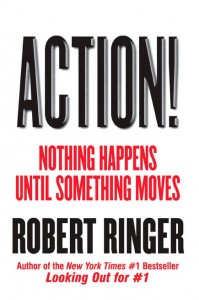
I recently received a nasty e-mail from someone who implied he had read my book Action! Nothing Happens Until Something Moves.  He lashed out at me with a vengeance and resorted to some pretty nasty name-calling.

What was he so ticked off about?  Would you believe it was because, in the first chapter of the book, I briefly discuss my belief that there is an infinite source of power in the universe that no one fully understands?  When I say no one, that includes the most cerebral scientists on the planet.  The most remarkable discovery that resulted from the launching of the Hubble Space Telescope is that not only is all matter in the universe moving away from all other matter at lightning speeds, those speeds are actually accelerating.

Read Full Article

Knowledge Redeployment

By Robert Ringer - Thursday, December 14, 2006

My first love is learning, which is why I keep my brain on autopilot when it comes to absorbing everything around me and extracting lessons from what I see and hear.  It borders on an addiction.

Extracting knowledge, however, is not enough.  You must be able to apply what you’ve learned to other situations — even situations that are far removed from the one where the original knowledge was acquired.  I like to refer to this skill as “knowledge redeployment.”

Read Full Article

The Customer-Employee Challenge

By Robert Ringer - Monday, October 9, 2006

For many years, I felt a moral obligation to inform business owners whenever I thought they had a personnel or customer-service problem on their hands.  I say moral obligation, because I have always been grateful to customers — or anyone, for that matter — who have taken the time to clue me in on any aspect of my business which they felt was not up to par.

I use the past tense here because, sadly, I rarely volunteer my observations anymore.  The inherent urge to be of help to a fellow entrepreneur or business owner still resides within me.  The problem, however, is that too many business owners have demonstrated that they are neither interested in, nor serious about, receiving such feedback.

Read Full Article

Defying Historical Patterns

By Robert Ringer - Thursday, September 7, 2006

Life is filled with paradoxes.

Example:  You spend decades learning the rules of the game.  Then, just about the time you’ve managed to accumulate some meaningful wisdom, the game ends.

Read Full Article

Keeping Your Eye on Your Burger

By Robert Ringer - Saturday, June 11, 2005

Ray Kroc, founder of McDonald’s, never grew tired of preaching to his executives that McDonald’s was, first and foremost, in the hamburger business.  While it was somewhat of a necessity for the company to expand its menu to include non-hamburger sandwiches and other items such as salads and ice cream, Kroc intuitively understood that a company should never lose sight of its main business.

Which brings me back to Microsoft and the Digital Entertainment Lifestyle war.  The combination of Microsoft’s $34 billion in excess cash coupled with Bill Gates’ brain, business acumen, marketing genius, and killer instinct makes it hard to bet against the company, even if it decided to go into the hot dog business.  But the problem with Microsoft’s participation in the video-game wars is that it appears Gates’ skills are being bypassed.

Read Full Article

Beware the Lure of the DEL

By Robert Ringer - Saturday, June 4, 2005

If you weren’t already enamored with Bill Gates, you had to be impressed by the fact that he was recently on the front cover of not one, but two major magazines — Time and Fortune.  What makes this especially remarkable is the fact that the two cover stories, which came out at virtually the same time, focused on totally different aspects of Microsoft’s business.  Imagine having such a great impact on the world that two major publications believe, simultaneously, that two totally unrelated divisions of your company are worthy of front-cover stories.

In today’s article, I’m going to weigh in on the essence of the Time piece on Gates/Microsoft.  The Time cover story wasn’t about the ongoing saga of the next version of Windows or some sexy new Microsoft acquisition.  Rather, it was focused on the Microsoft monster that plans to devour not only your kids, but you.  What I am referring to is the dreaded Xbox 360, due to be released in late November.

Read Full Article

Common Sense

By Robert Ringer - Saturday, May 7, 2005

An interviewer once asked Dr. Phil if it bothered him that so many critics accused him of oversimplification.  He responded that it didn’t bother him at all.  He even volunteered that one fellow had recently accused him of saying things that were really nothing more than common sense — to which Dr. Phil responded, “Golly, that’s great.  Do you mind if I use it as a testimonial?”

It was a very clever way of turning a negative into a positive.  And the nice thing about it was that it was true.  The greatest teachers have a knack for demystifying complex issues by applying common sense to them.  But just what is common sense?

Read Full Article

Dealing With Injustice

By Robert Ringer - Saturday, April 9, 2005

Prominently displayed in the main hallway of my son’s school is a large sign that lists  “Life’s Rational Rules of the World.”  There are twelve altogether, and the first rule on the list reads:  “The world is not always fair.”

From the first time I saw that sign, I was impressed with the school.  What a great truism to emphasize to children, because, throughout their lives, they will continually be confronted by injustice.

Read Full Article

Above All, Discretion

By Robert Ringer - Saturday, March 5, 2005

There’s no question that some fans felt cheated when they found out that major league baseball players have been using performance-enhancing substances for years.  It appears, however, that they are in the minority and that most fans don’t really care all that much about steroid usage.

At the very least, they’re willing to forgive and forget.  I think my teenage son’s attitude is typical:  “I don’t care if players use steroids.  I just like seeing home runs.”

Read Full Article

Celebrating Our Commonality

By Robert Ringer - Saturday, December 25, 2004

This being December 25, I thought it would be appropriate to pen a few words about Christmas.  For starters, Christmas is a good time to put aside our diversities and celebrate what we have in common with one another. More than 80 percent of Americans are Christians, while Jews comprise slightly more than 2 percent.

Yet, notwithstanding the disparity in numbers, Christians and Jews are forever joined at the spiritual hip as a result of their commonality.  Jesus Christ was born a Jew, practiced and preached Orthodox Judaism throughout his life, and died a Jew.  Further, Christians throughout history have always believed in the Old Testament (i.e., the Jewish Bible).

Read Full Article

Time Warp

By Robert Ringer - Saturday, December 11, 2004

College football rivalries such as Army-Navy, Texas-Oklahoma, and Ohio State-Michigan involve much more than just games. They are bigger-than-life spectacles.  So it was a big deal for my teenage son when I took him to what is arguably the greatest rivalry in college football, the Ohio State-Michigan game.

Usually when I take my son to a sporting event, I don’t care all that much who wins.  Being genetically programmed to be a social observer, I just enjoy the festive atmosphere and overall experience of the occasion.

Read Full Article

To Receive Free Daily
Articles Via E-mail
Click Here

Featured Columnists

Liberty Education
Interview Series

Robert Ringer interviews top political, economic, and social leaders on today's most vital and controversial issues.

Grover Norquist Interview

Featured Interview:
Grover Norquist

Audio file loading...

More Interviews


Recent Comments

  • Hugh May 22, 12:55 PM
    on The Repudiation of Romney the Repudiator Sorry, Robert, Obama is right. The election IS about Bain Capital; it's the symbol of...
  • Obomney May 21, 11:28 PM
    on Romney Nightmare: Ron Paul Resurfaces Yet Again So what are you freedom lovers doing to stop me from dick tating over the...
  • Rick May 21, 9:24 PM
    on Was Saving GM Worker’s Job Fair? If he hadn't bailed them out, our country's unemployment insurance system would have been overloaded...
  • Bill May 21, 4:45 PM
    on John Stossel on Intuitively Trusting the Government Your bullet point questions are excellent, could not have been stated better. ["defective intuition —...
  • Marte May 21, 3:11 PM
    on John Stossel on Intuitively Trusting the Government Robert - What I want to know is how we can use gradualism to turn...